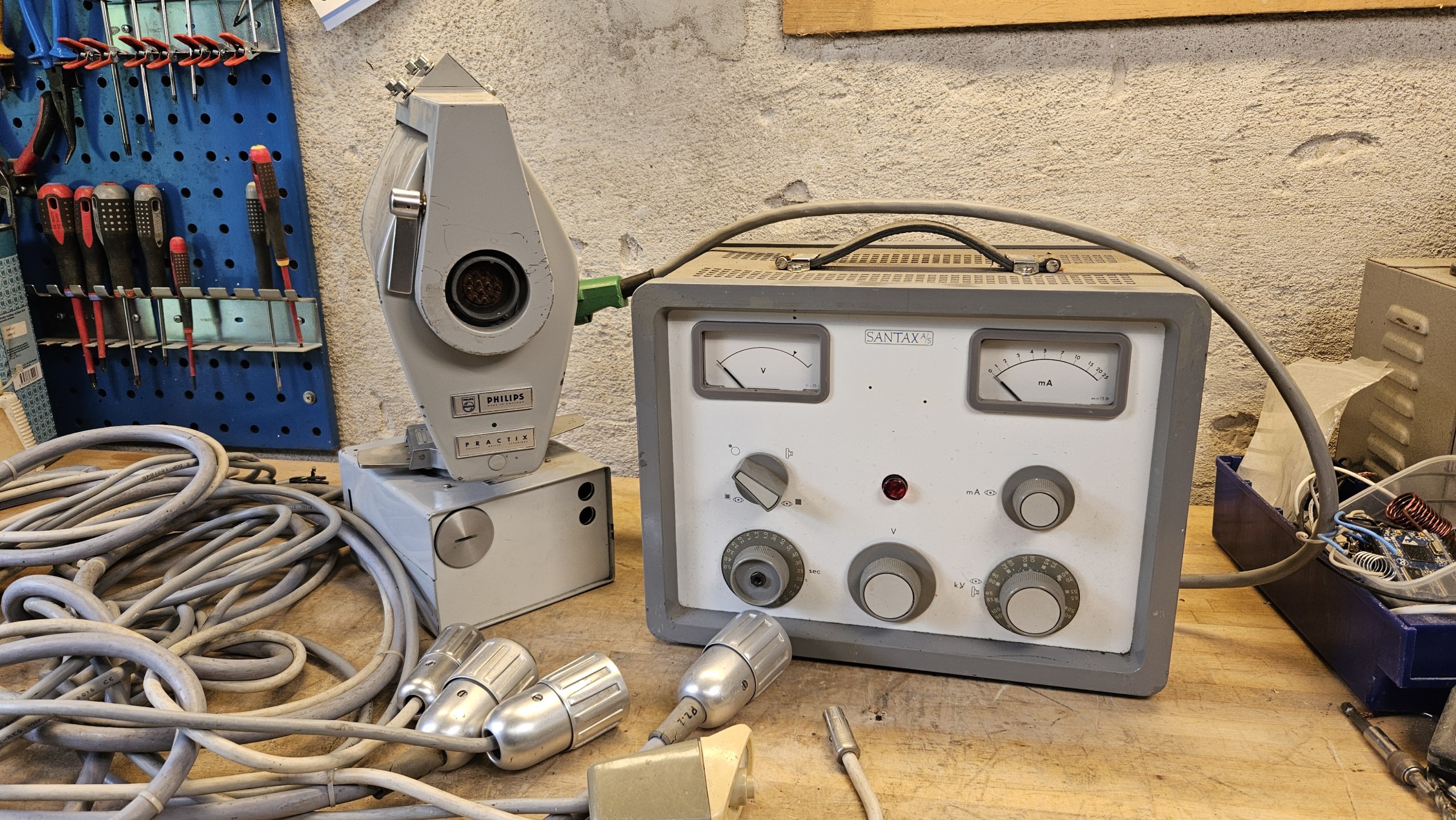
This is a teardown of a complete x-ray system, with control panel, x-ray head with high voltage transformer and collimator. The Philips Practix system is a mobile system, usually mounted on a trolley, with the x-ray head on a separate arm assembly. It has a large and small focus fixed anode X-ray tube, the maximum ratings are 100 kV and 25 mA. The change between large and small focal point, is done by mechanical switching inside the tube.
If you want to see more x-ray equipment teardowns, you should check out these systems. Philips Medio 50 kW CP-H X-ray Control Desk Teardown. 50 kW Sedecal SHF-530 X-ray High Voltage Generator Inverter Teardown. Showa SP-103 Standalone X-ray Head Teardown. Siemens Polyphos 30 X-RAY Head 125kV Teardown (Part 1 of 3) or GE AMX-II, mobile 110kV X-RAY system teardown.
Philips Practix X-ray Control Panel
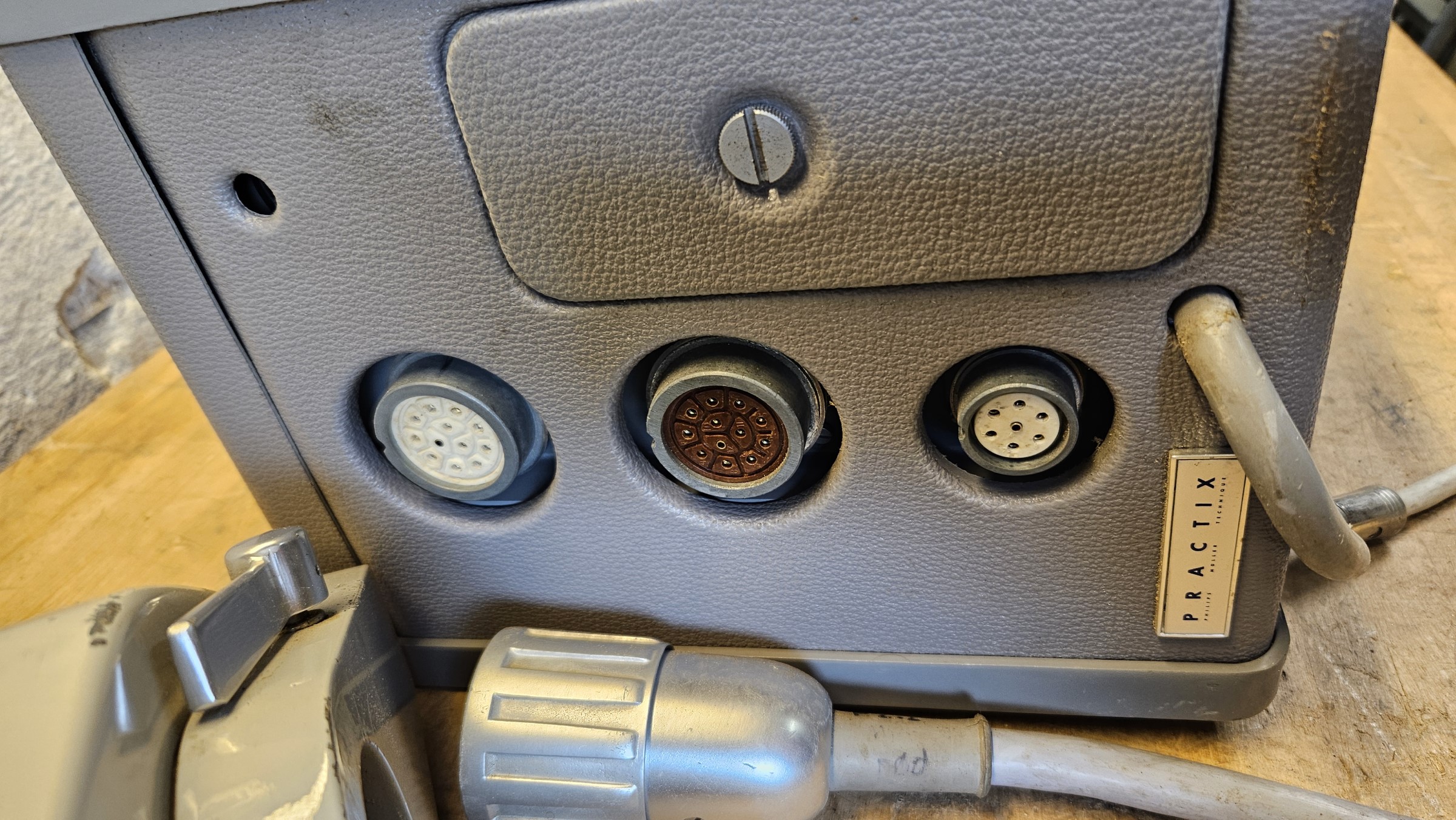
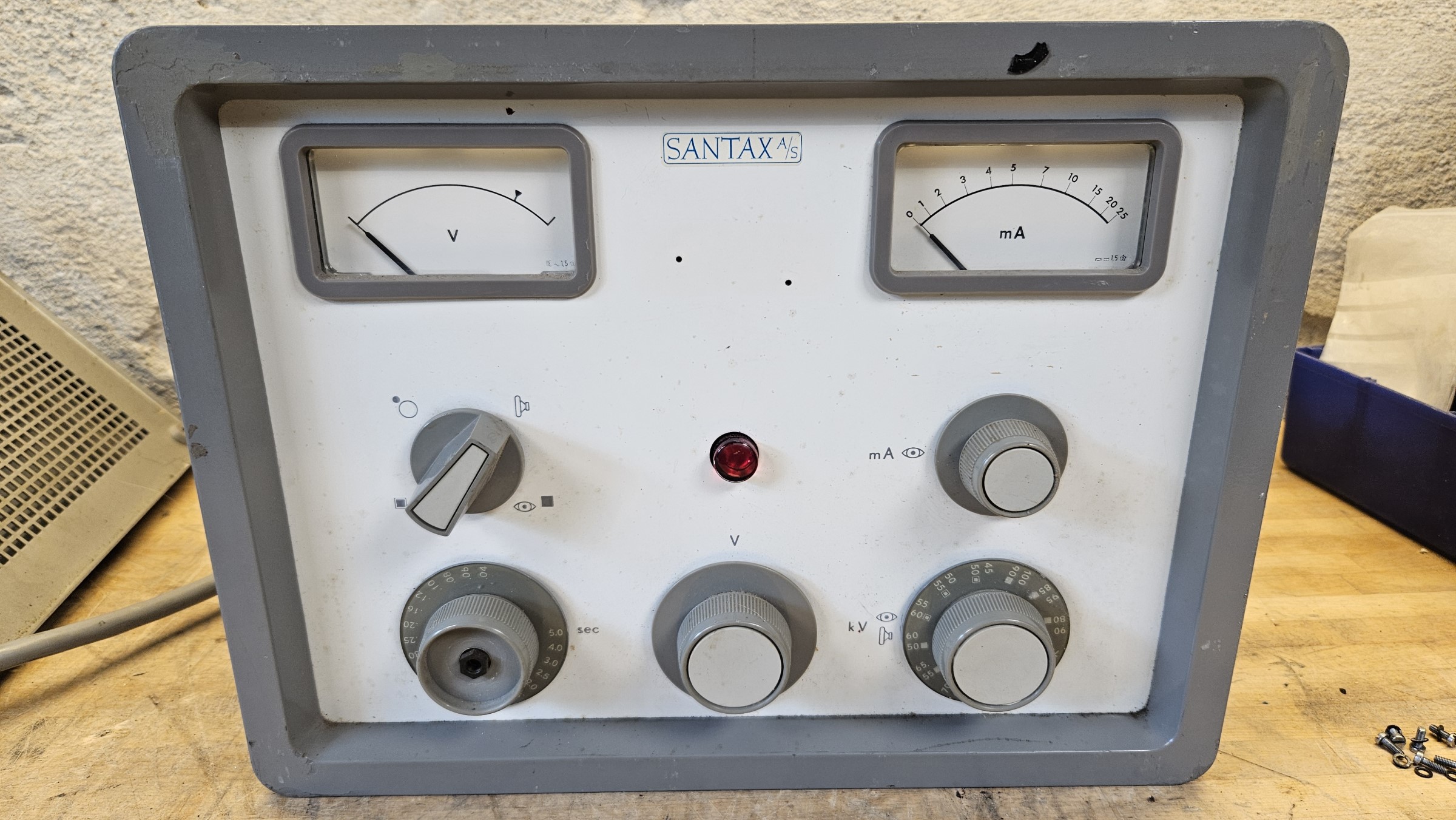
The Philips Practix system has three cables attached to the control panel. One for powering the high voltage transformer in the head, one for lighting in the collimator and a third cable for the double actuating switch. The control panel has settings for voltage and current, marked to the large or small focal setting. Voltage can be fine adjusted to suit the line voltage fluctuations at the site of use. The timer has 21 steps from 0.04 seconds to 5 seconds exposure time.
Inside the Philips Practix control panel
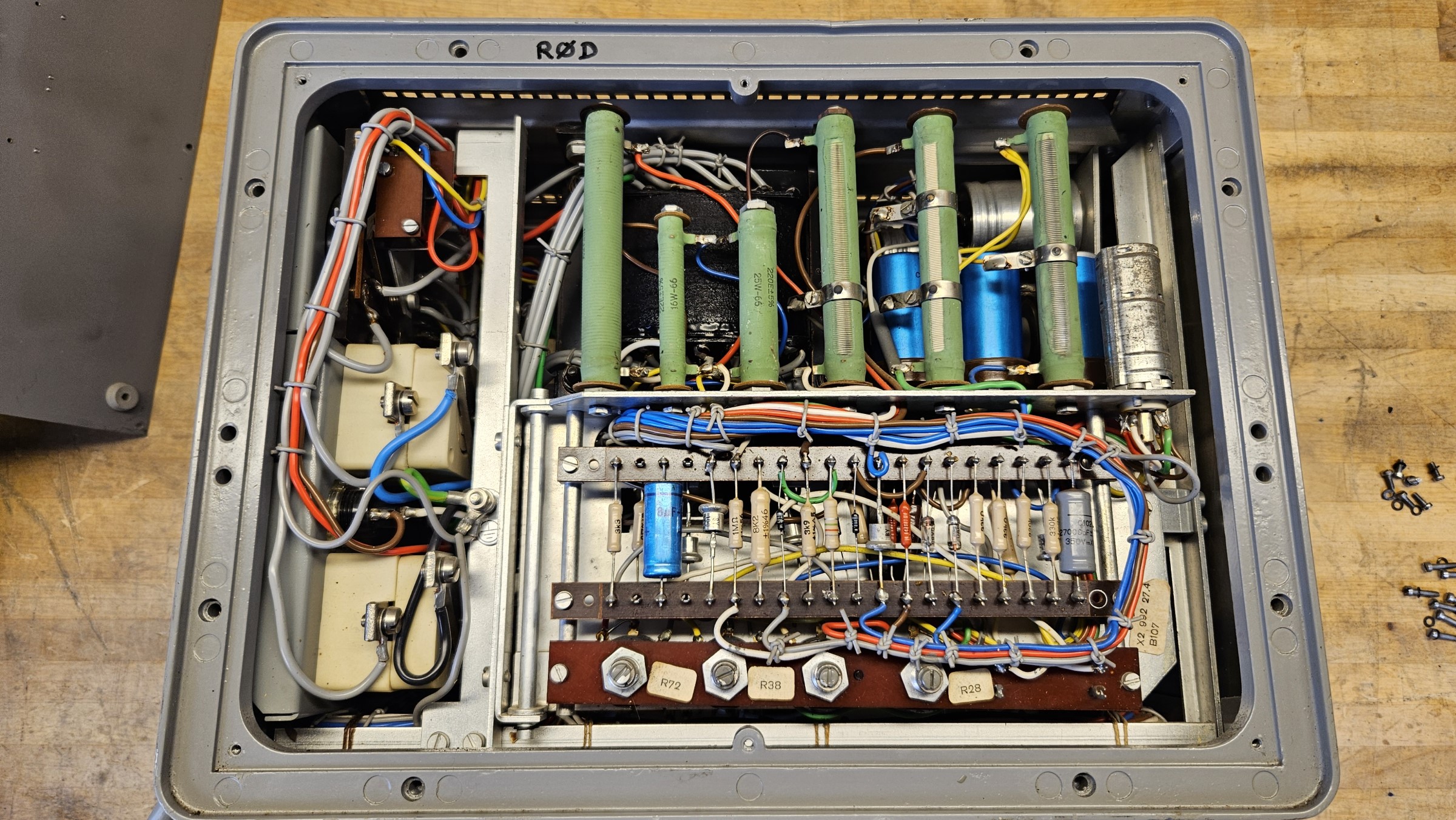
The inside of the control panel reveals that it is divided into two major separate circuits. Everything with gray wires is for mains power to the high voltage transformer. Almost everything else with a colored wire is for the timer circuit. There is no programmable parts, the only complex part is a single vacuum tube used in the timing circuit. Everything else is resistors, diodes and capacitors. The large black transformer inside the control panel is used for voltage adjustment, related to mains power fluctuations. A cam wheel on the kv / mA / aperture selector is used to switch between large and small focal point. This switch powers an actuator inside the x-ray head, which turns the cathode of the x-ray tube, for switching focal mode.
Inside the Philips Practix x-ray head
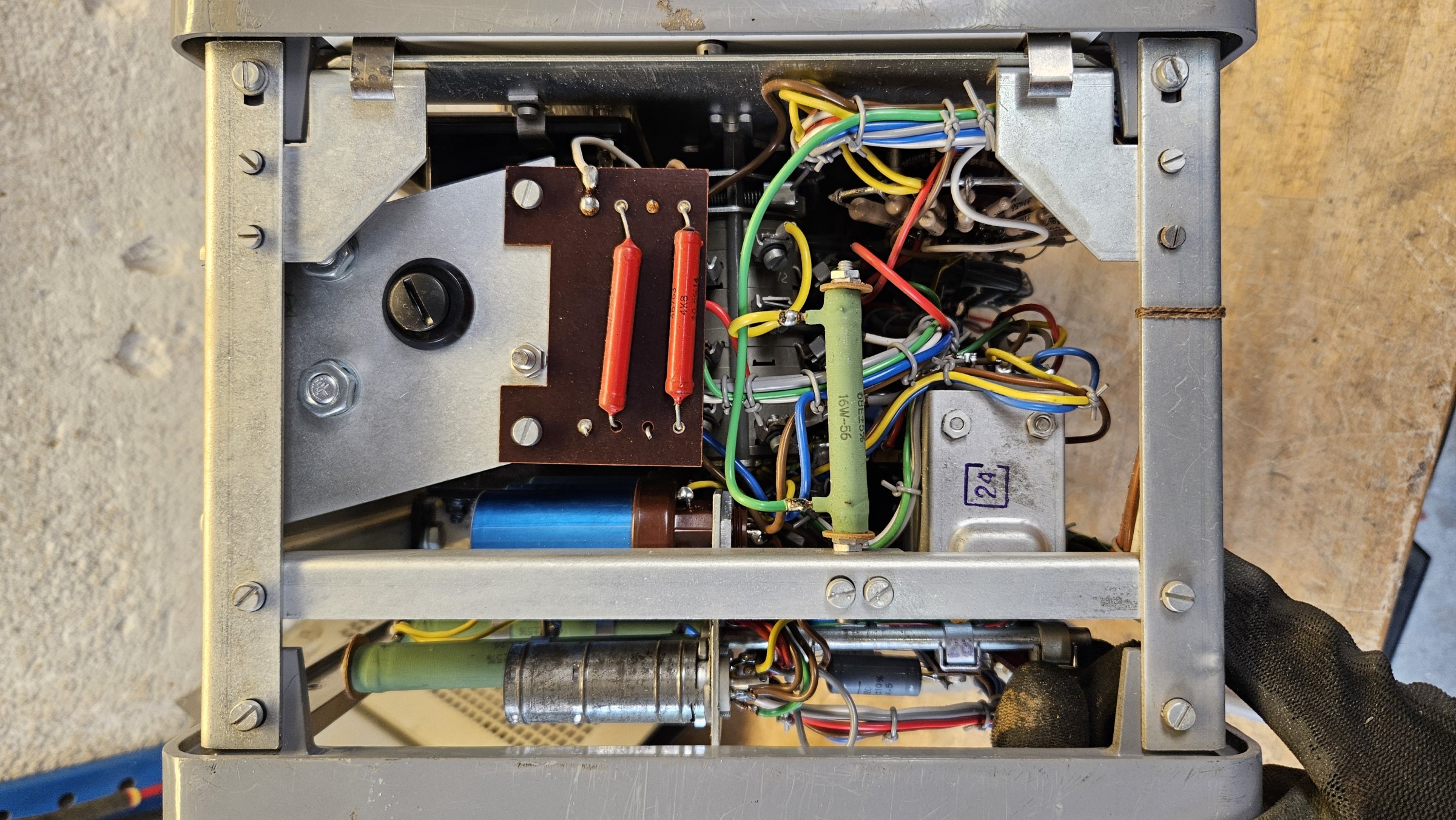
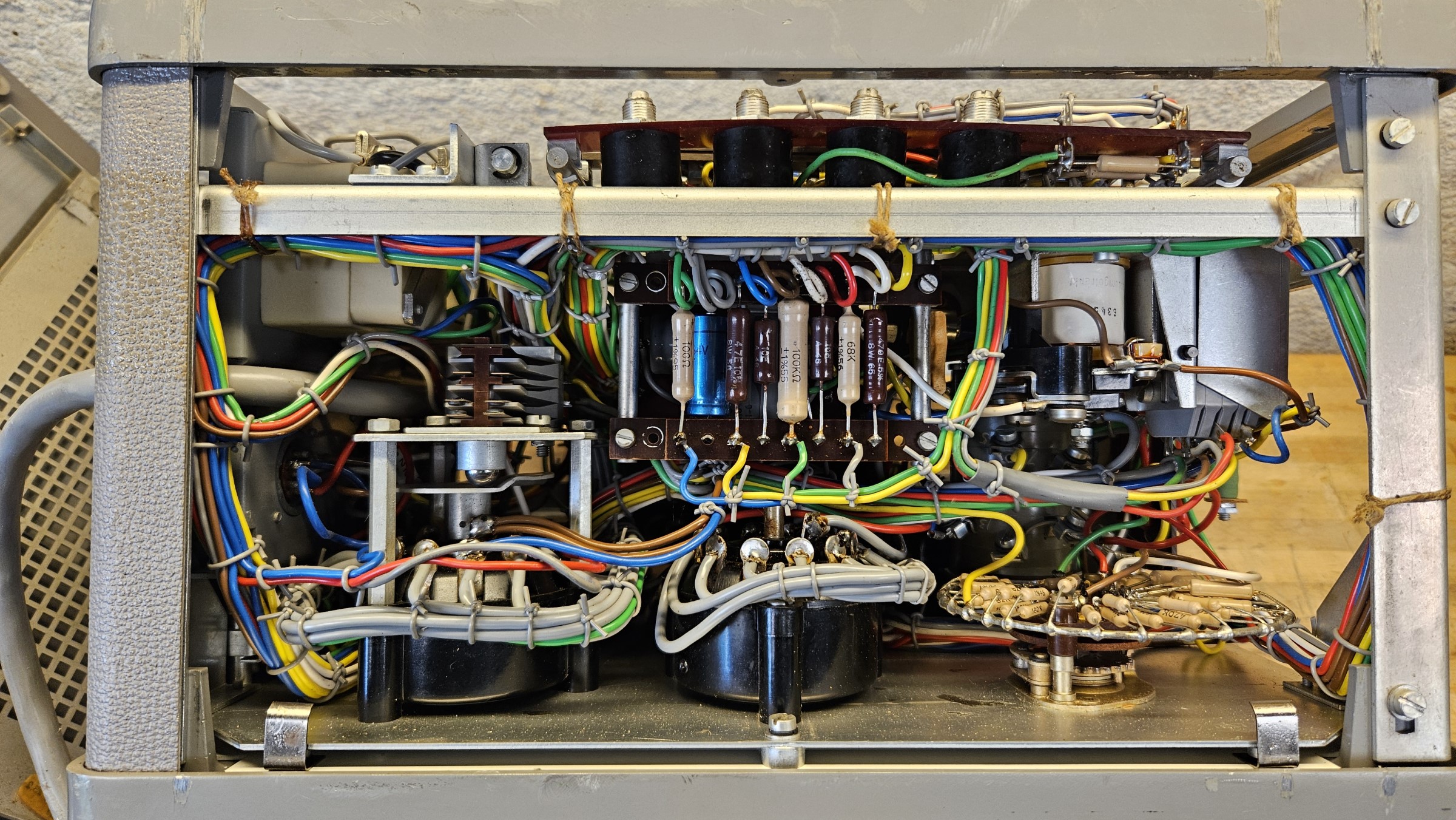
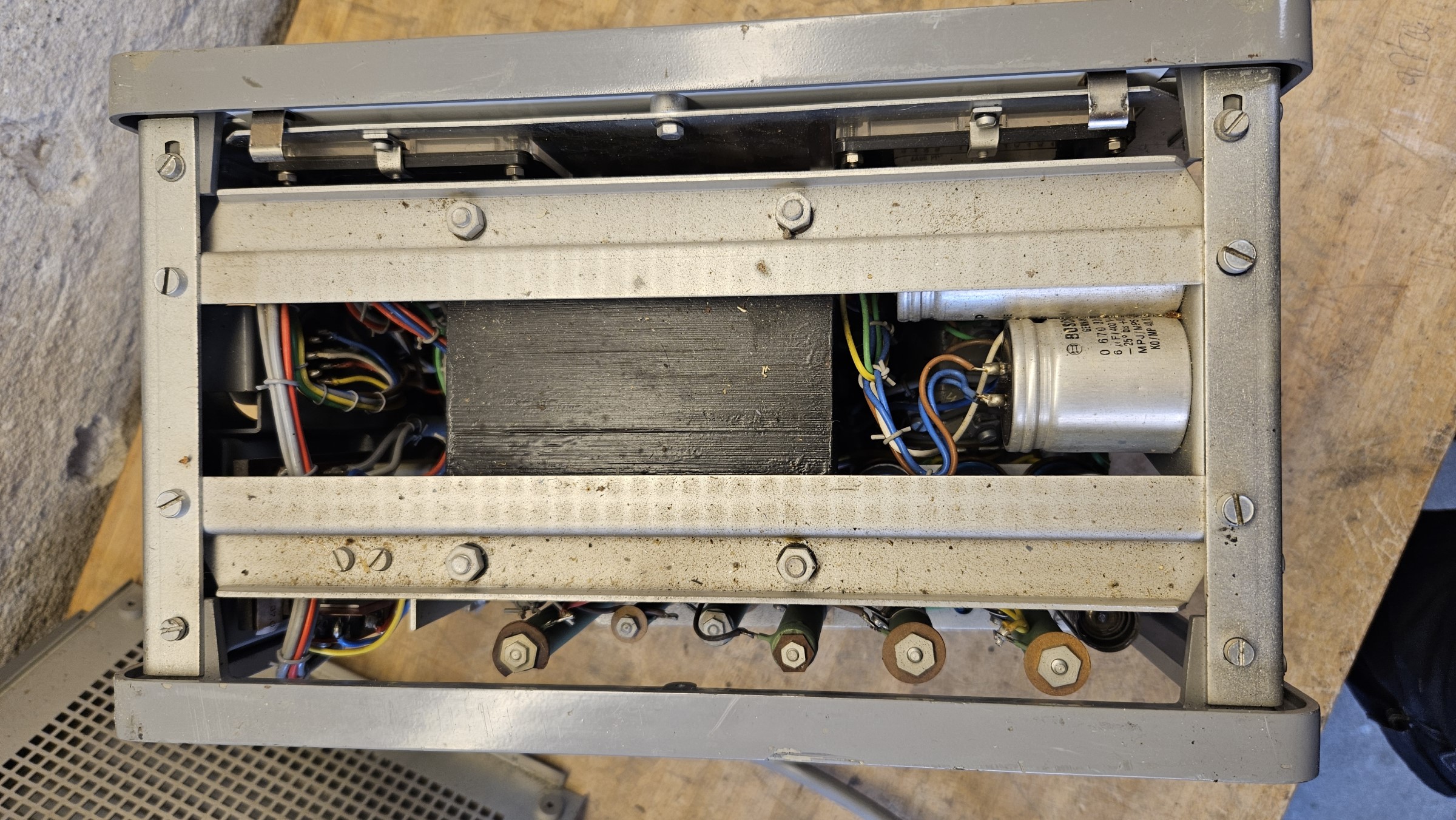
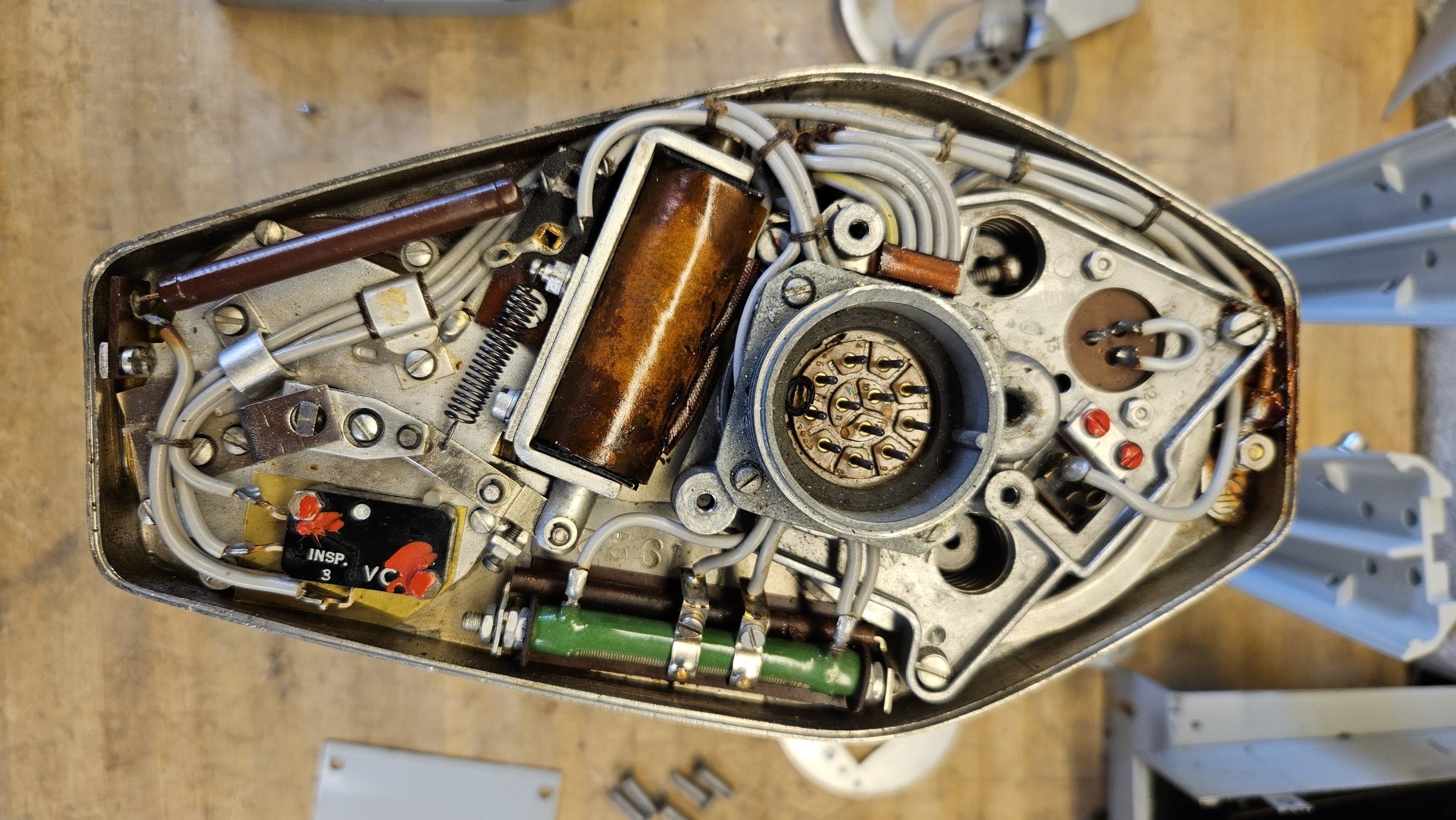
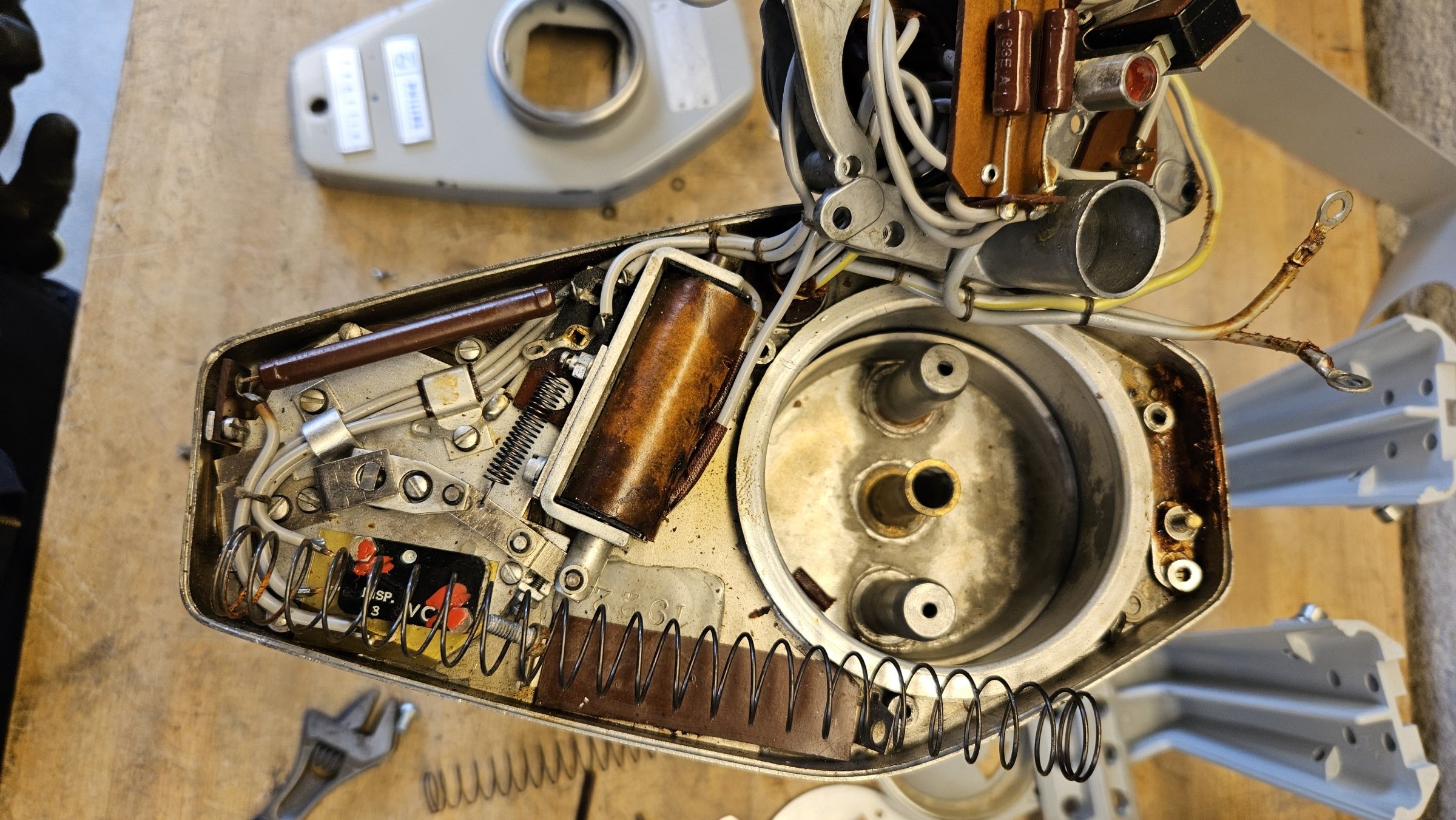
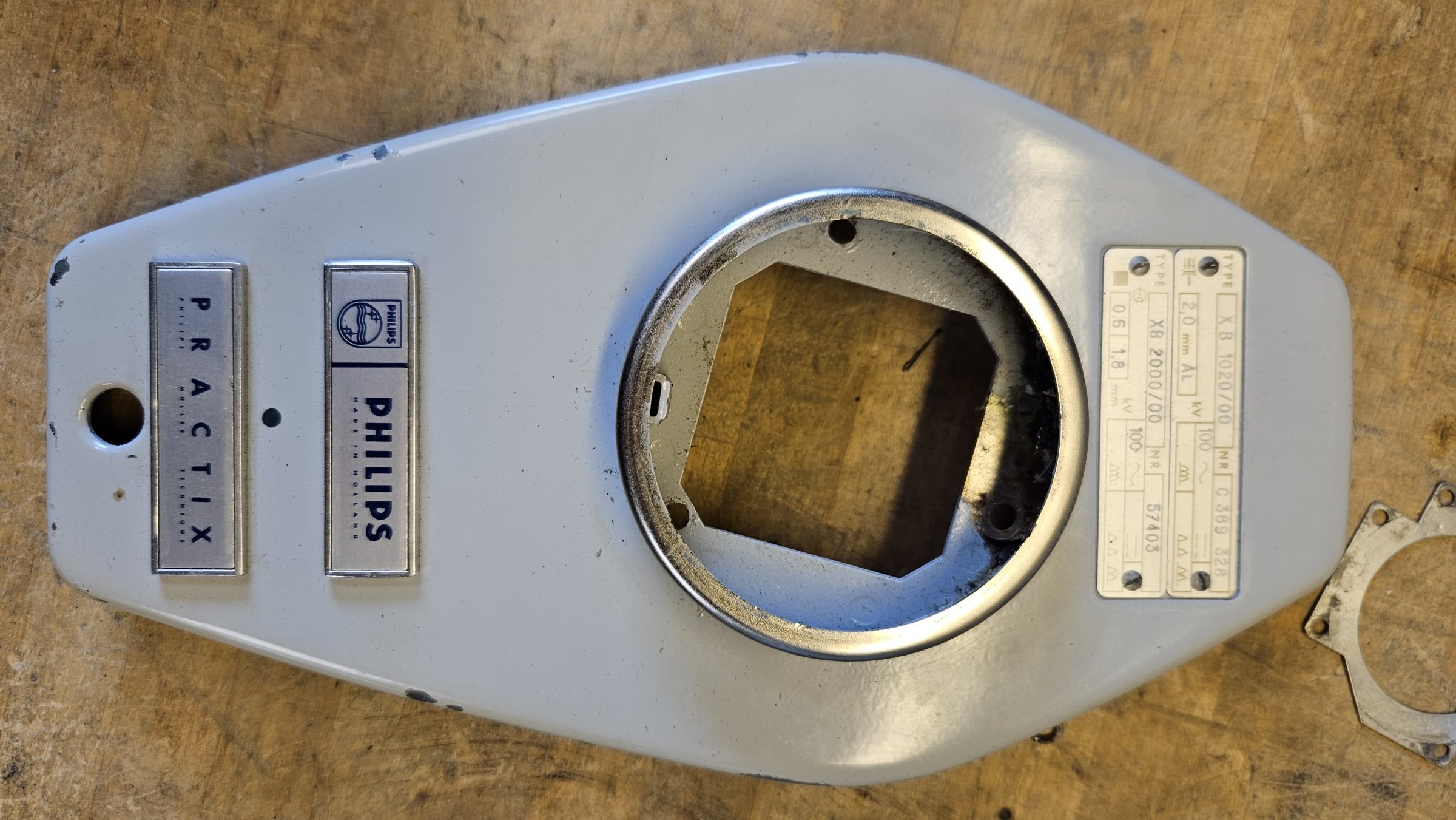
Inside the x-ray head enclosure, there is a few things going on, on the outside of the shell. A vacuum / expansion chamber, makes it possible the oil to expand from excessive transformer heating. A single end switch is used to detect if the brass knob in the middle is extended too far. The brown solenoid is the actuator for changing focal point. Various resistors are most likely used fail safe wiring termination, that a certain resistance in the circuitry is needed for correct function, else it will fail and not operate.
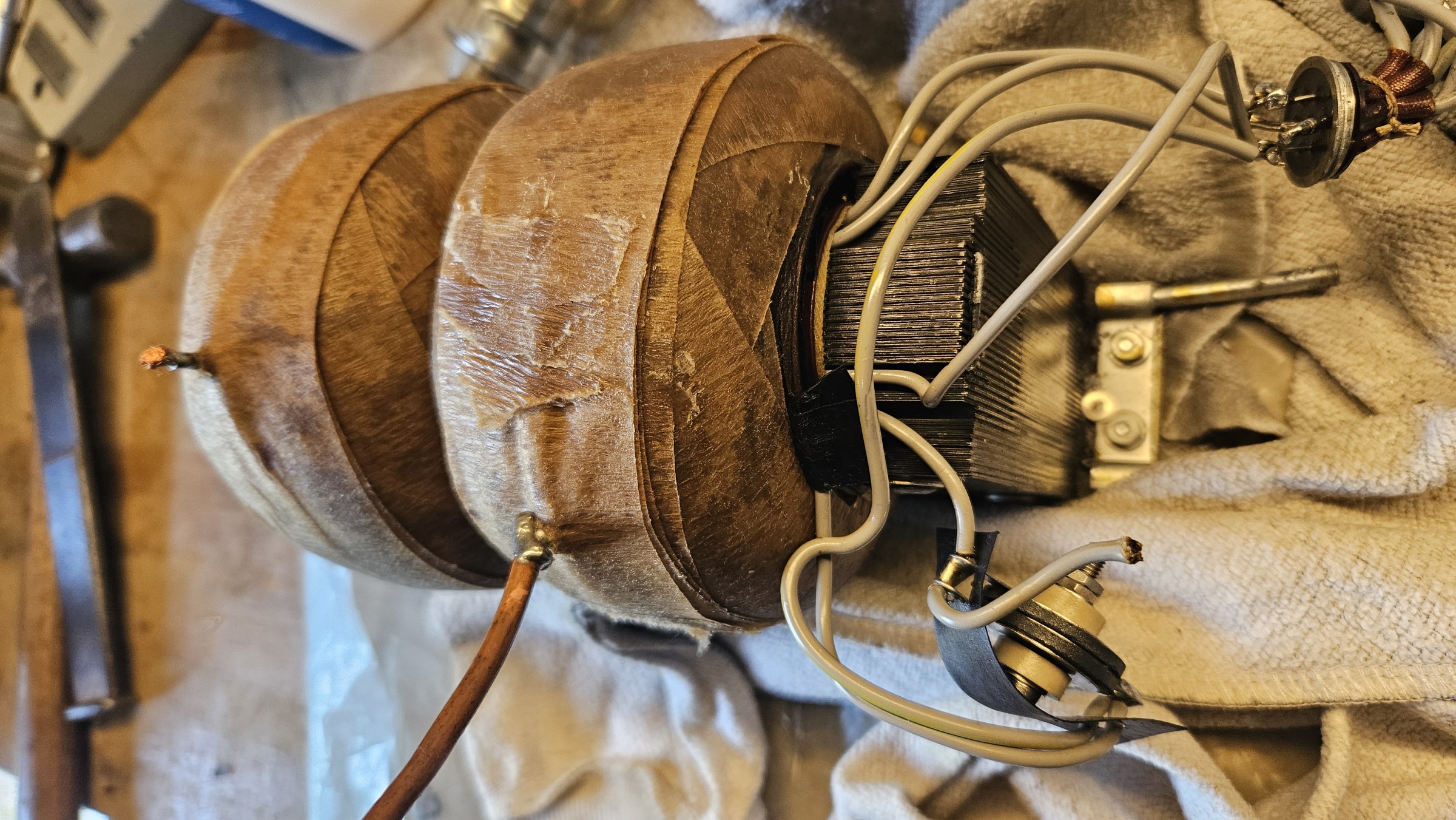
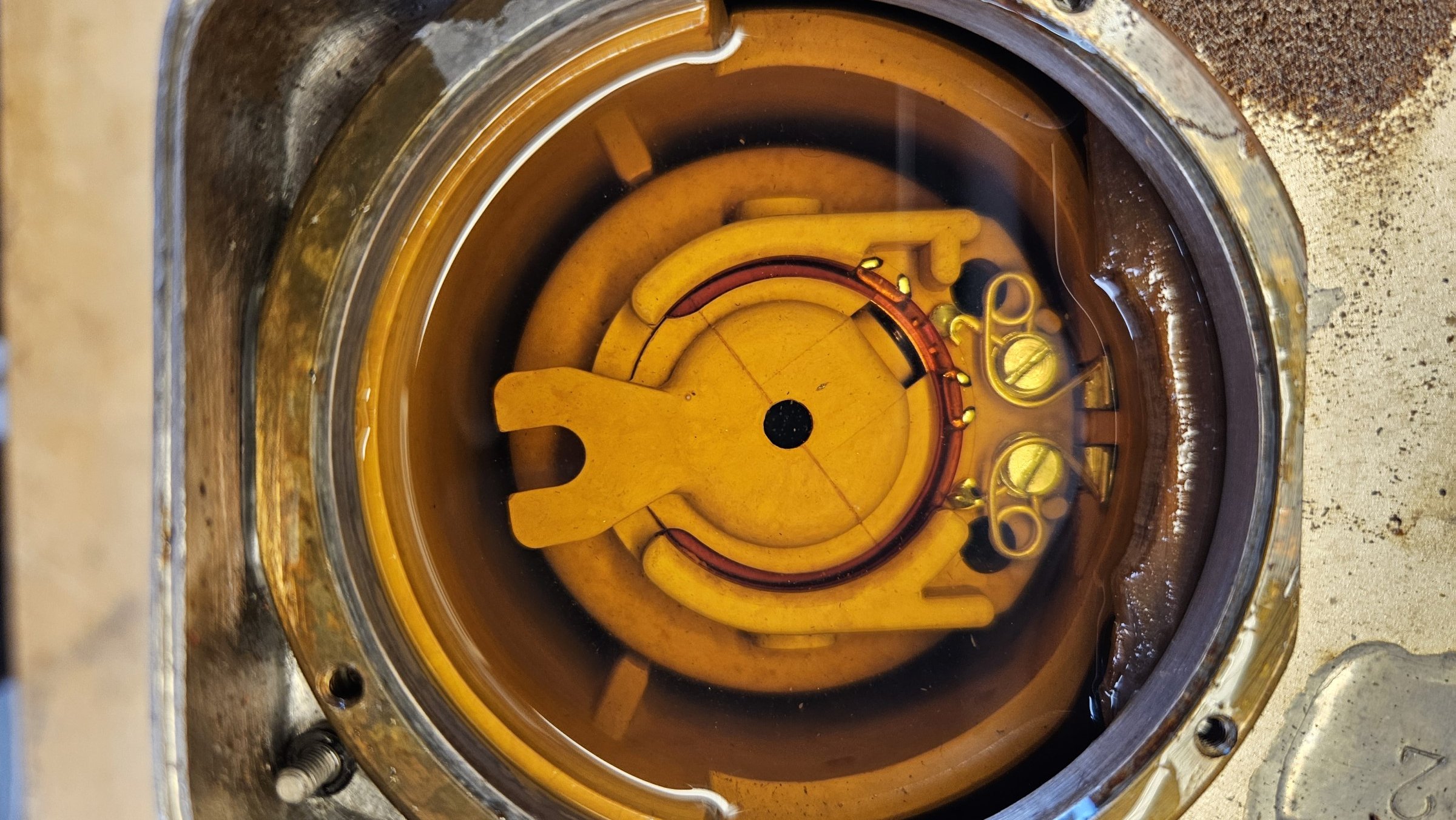
The x-ray tube is marked 57403 and 62220. The first number is likely the tube type number, but it was not possible to locate a datasheet on it. 62220 refers to the international standard for x-ray medical devices. The high voltage transformer is purely AC, there is no diodes present in the tank. It consists of two windings, most likely midpoint grounded for easier insulation against two times 50kV, instead of full 100kV. Midpoint grounding also makes it easier to do current measurements across a shunt resistor placed at near ground level voltages.
The eye symbol on the controller means “fluoroscopic exposures”, these are long exposures (several seconds) and the x-rays are viewed on either a fluorescent screen (not now), of via an image intensifier. This setting will bypass the timer, and the exposure length is controlled by the operator releasing the exposure control.
The “speaker” setting, means “radiograph exposure” (i.e. a normal x-ray), with the exposure time set by the timer. X-Rays are captured on film (today we tend to use digital image capture.
Thanks David, so basically just a live view and normal exposure. Wouldn’t exposure length still be limited by power supply limit for voltage sagging or temperature rising in head?
Hi Mads,
For fluoroscopy (live view), x-ray systems generally operate with a tube current in the range 0.1mA to 4mA. For radiography (normal exposure), the tube current (on this system) is about 15mA (large systems in hospitals run at upto 1000mA). Therefore “sagging” is not likely to be an issue in fluoroscopy – the generator is designed to deliver this power continuously for several minutes.
The x-ray head does get warm
The only means of cooling the target (anode) in the glass tube is by radiant infra-red emission to the insulating oil within the x-ray head assembly. As this oil heats up it expands. There is normally a small rubber blister (acts as a bellows) to allow for the expansion. There will be a microswitch close to the bellows that will activate if the bellows extends beyond a certain point. Often this will be when the oil is at about 80 centigrade. Activation of this microswitch inhibits x-ray exposure until the oil has cooled. The switch then resets as the bellows returns to a less expanded state.
Another limitation is the heating of the target (anode) and local melting can occur if the system is abused. Modern x-ray sets have safeguards to prevent this, but you have a very old system and I don’t think there is protection for the target from abuse