In this video we put together the components, found in part 1, that is needed to build the DRSSTC design that was done in 10’ish minutes. This video focusses on how good looking construction can be done with simple tools. No 3D printer or expensive tools are needed. Imagination and craftmanship is enough to get great results!
To learn much more about Tesla coils, DRSSTC topology or see other reference designs of Tesla coils, check out all the different models I have constructed!
Construction and Assembly
13th April 2026 to 15th May 2026 was spend on making circuit boards, populating printed circuit boards, construct all mechanical parts and prepare terminations for the final electrical connection between parts.

I value good craftmanship and simpleness, 3D printers and laser cutters are not basic needs for DIY. The amount and complexity of tools used, is kept to a minimum:
- Drill press
- Hand drill
- Tapping set
- Wood saw
- Hack saw
- Wise
- Hammer
- Overhead router
- Soldering iron
Enclosure and platforms
The enclosure is made from two 8mm plywood discs, 30 cm in diameter and with four 20 cm wooden standoffs between them. The weight of the primary coil, MMC, secondary coil and topload, does not dictate that a more sturdy construction should be needed.
The 30 cm plywood discs are easily made with a modified overhead router. A metal rod is drilled into the side of the router frame, with an adjustable clamp nut on it. The clamp nut originates from the terminal of a large electrical contactor. The screw of the clamp nut is used as the center of the needed circle cut and its position on the metal rod is the radius of the circle, to the edge of the overhead routers tool insert.


Power electronics
The full-bridge PCB is not populated with TVS diodes, as I find it overkill. There is examples of TVS diodes across C-E junction of an IGBT that can cause breakdown failure, that would otherwise just be mitigated by the snupper capacitors. I originally planned for a single 2.2uF snubber capacitor, but due to space constraints is limited to one 0.47uF and one 0.1uF snubber capacitors. Testing and measurements will be used to verify if it is sufficient.
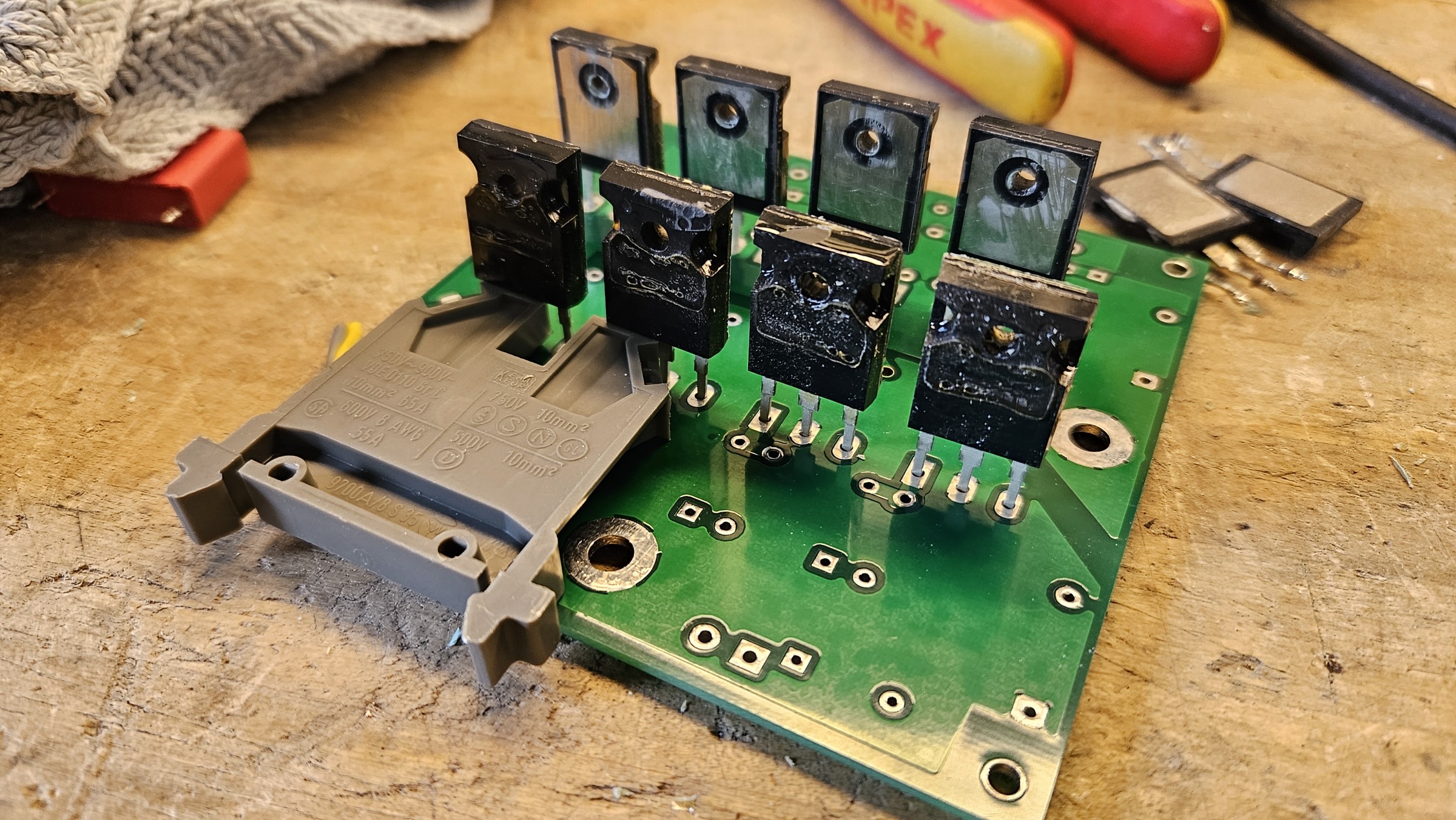
Two different heat sink solutions is tested. One type (Fairchild FGH40N60SFD) with screw holes and another type (Ixys IXGR40N60C2D1) with spring loaded clamp-on. IGBTs with screw hole is normally not with an isolated tab, so pads are used to avoid short-circuiting the entire bridge. Adding pads makes for a worse heat transfer, a alternative solution could be to cut the heat sink into four pieces, isolated from each other, they would however be floating at IGBT collector potential. The clamp-on IGBT in this case, is with isolated tap and therefore has superior heat transfer properties over the latter.




Primary coil
I chose to use 10mm thick acrylic for the primary holders, because I already had it in stock from making the DRSSTC 1! I chose to use 4 holders, by drilling 5mm holes spaced 10 mm apart, that pattern can just be shifted by 2.5 mm per holder and you get the pattern of a flawless spiral. A strike rail is added on the primary coil holder, slightly elevated in regard to the primary coil. All mounting to the base plate is done with nylon screws, to avoid metal being too near to the primary coil.


Secondary coil and Topload
The secondary coil is winded on a regular gray PVC sewer pipe and the supplied mounting set, uses an end cap from the same system. This end cap can only be used with the full pibe head and gasket. This either dictates a more complex platform construction or just go with the taller primary holders.
The mounting set did not include anything for the top of the secondary coil. I cut a piece from another 75 mm sewer pipe, cut a slot in it and glue it in place inside. A 73 mm diameter hole saw was used to make a disc that has a perfect fit, to rest on the slotted pipe piece on the inside. All glued together and only using nylon screws for the topload connection.


No metal on the inside of a secondary coil! This will help prevent internal flashovers inside the secondary coil.
The topload mounting hardware is replaced with a brass standoff, that provide a good mechanical and sturdy connection from the nylon bolt and ensures a good low resistance connection from secondary coil to topload. The secondary wire will be protected from direct wear of the toploads weight and jigglyness.
Driver
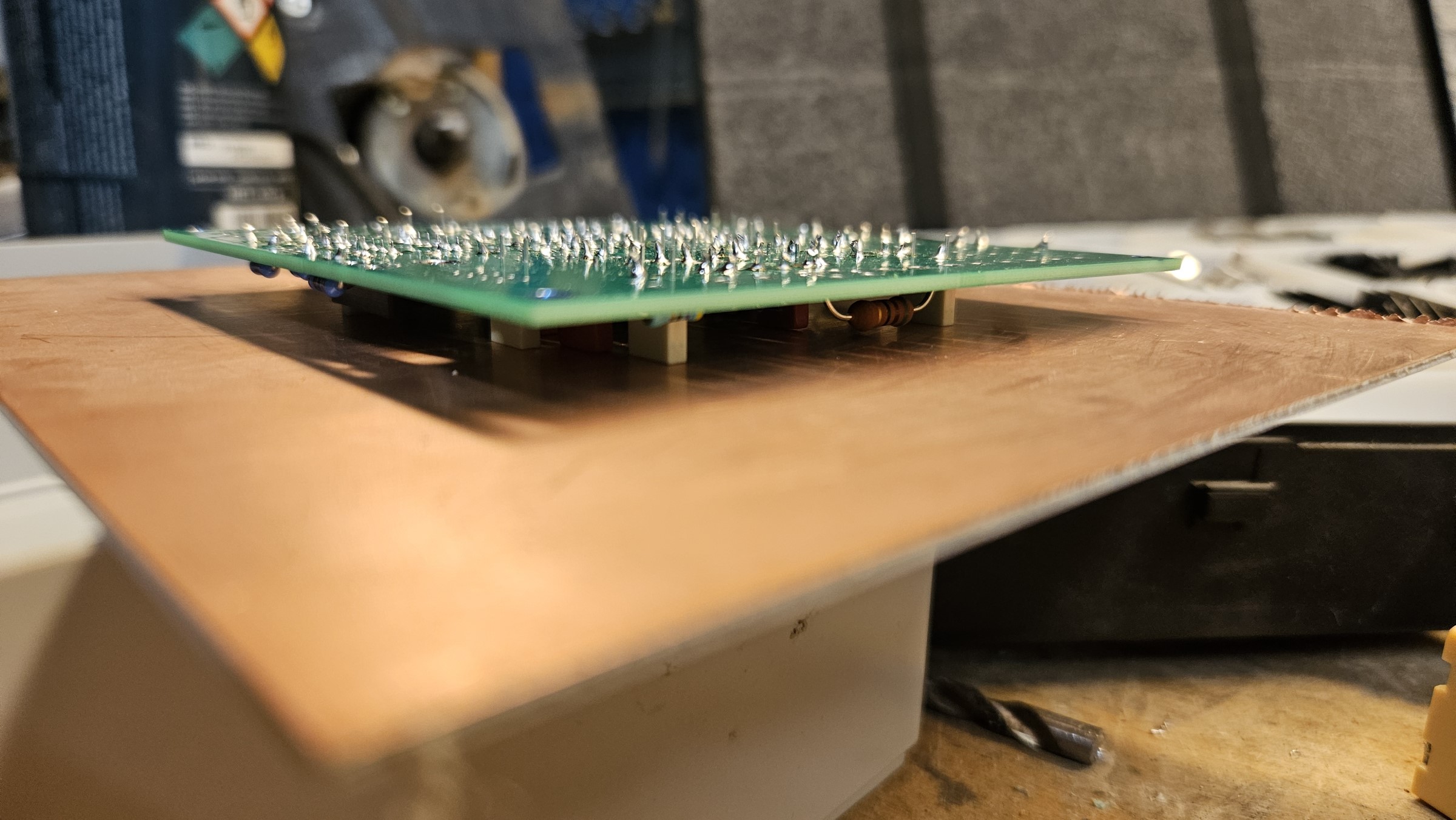
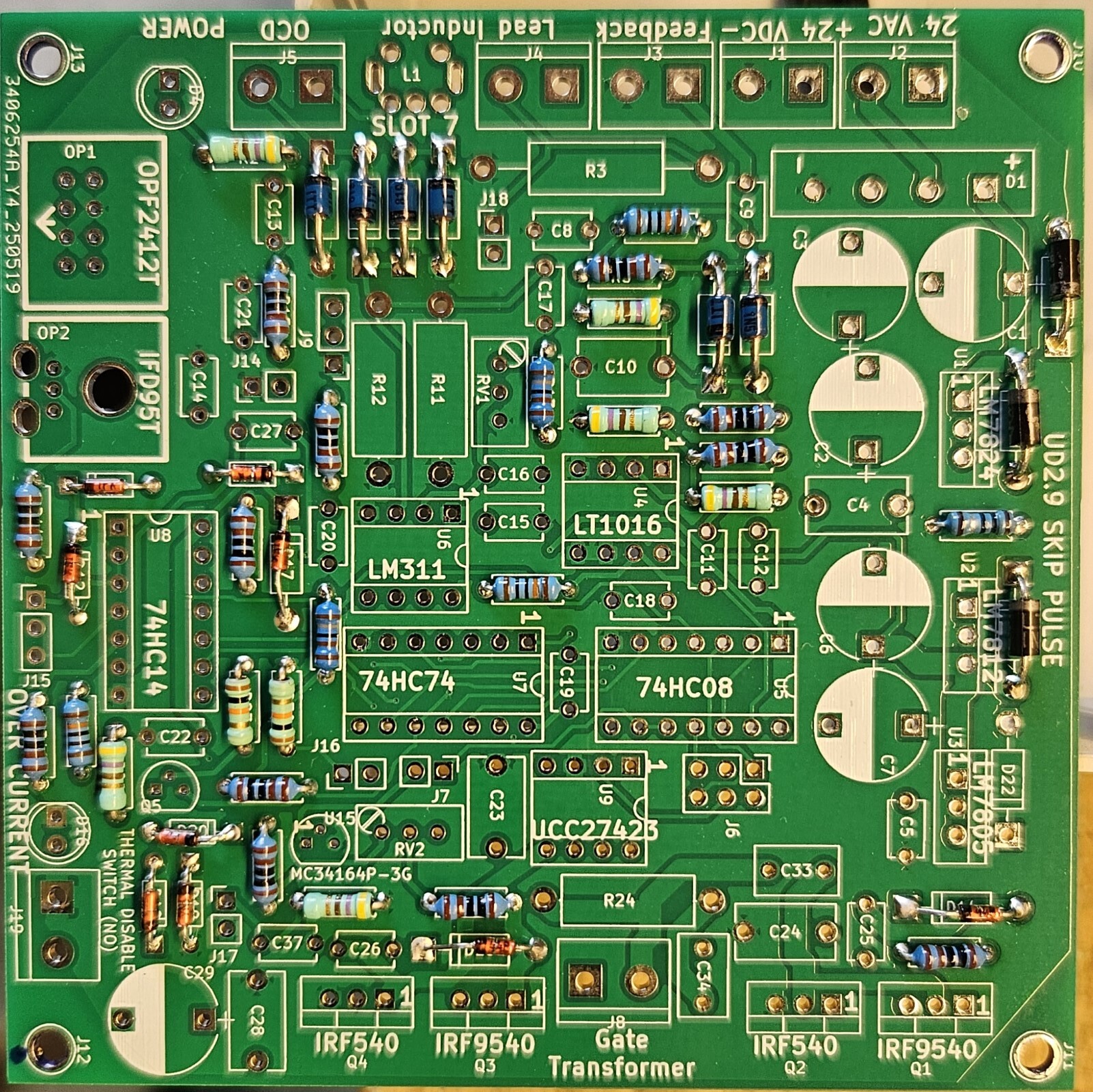
The driver used it the DRSSTC Universal Driver 2.9 (UD2.9 by prof9dc). When soldering through-hole components to a printed circuit board, bending the legs to avoid components falling out or displacing, is a common practice. Bent legs is however also a nuisance, if you have to change a defective part or do fault finding. I have solved this issue by soldering in components based on their height. By going from lowest to tallest component, I can populate the board, cover the components with a plate, turn it all up-side-down and easily solder all the components without them falling out. The sequence used for this printed circuit board was:
- Resistors and diodes
- IC sockets
- Small film capacitors
- Large film capacitors
- Terminals
- Electrolytic capacitors
- Transistors and voltage regulators


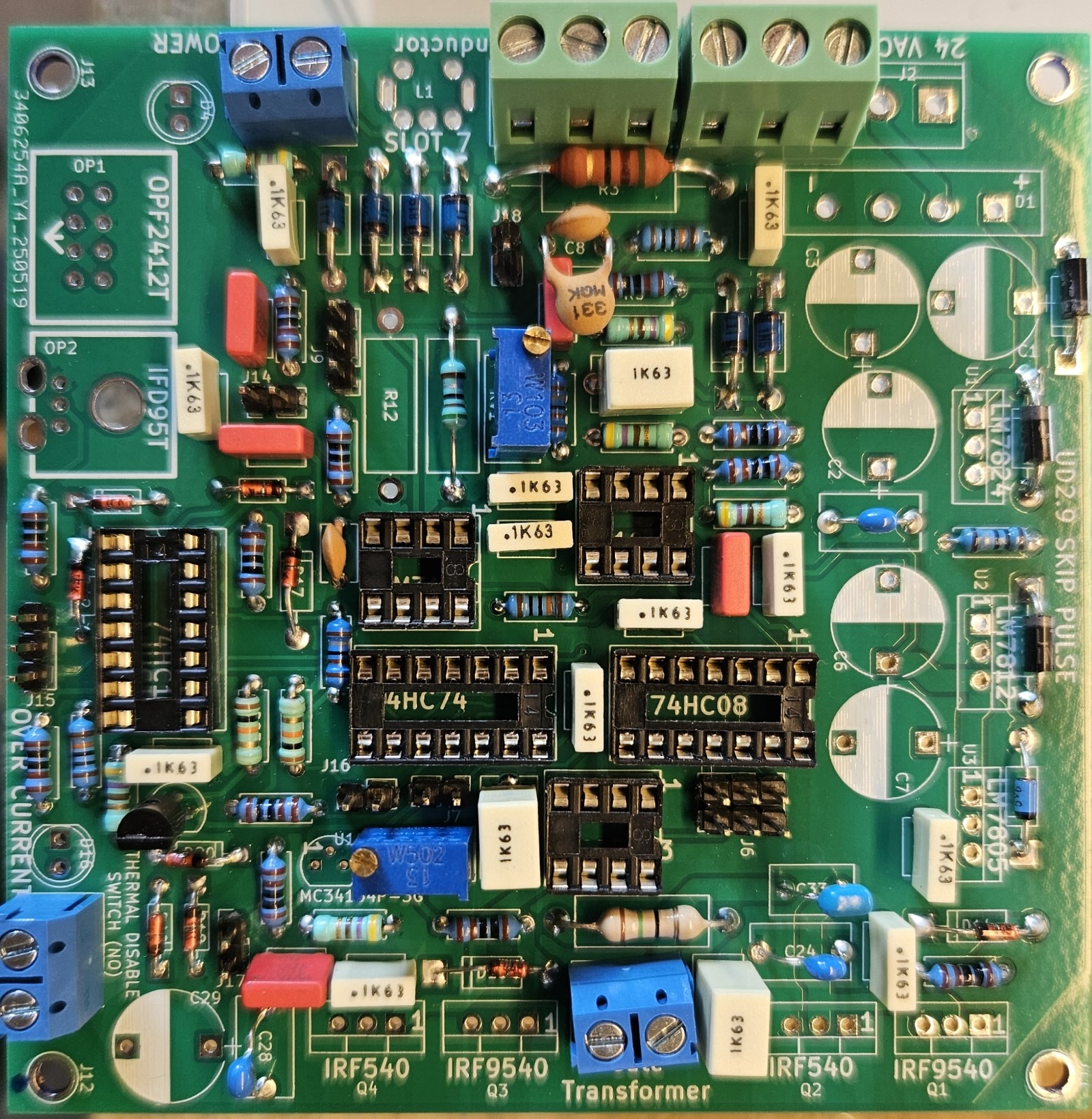

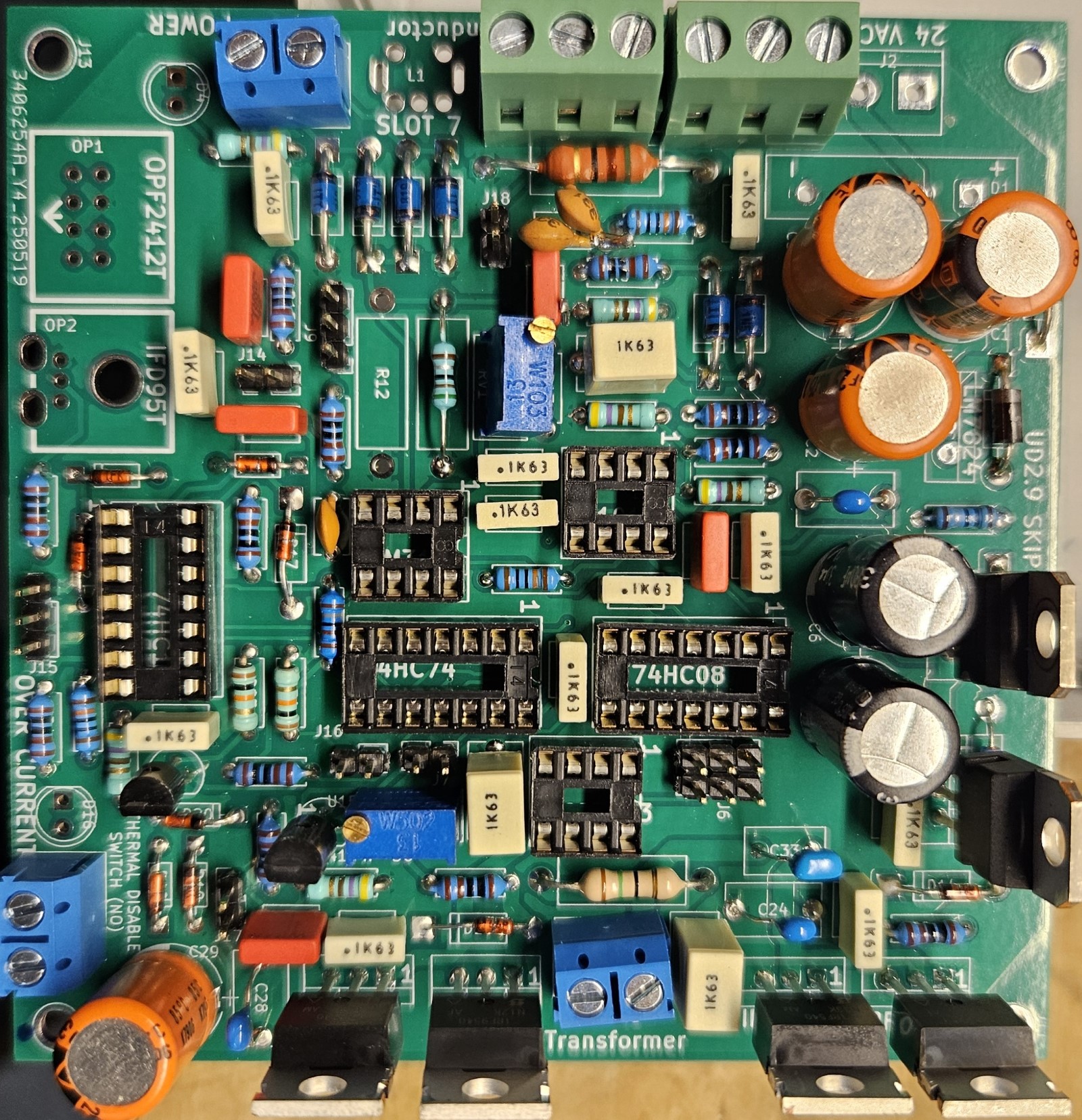
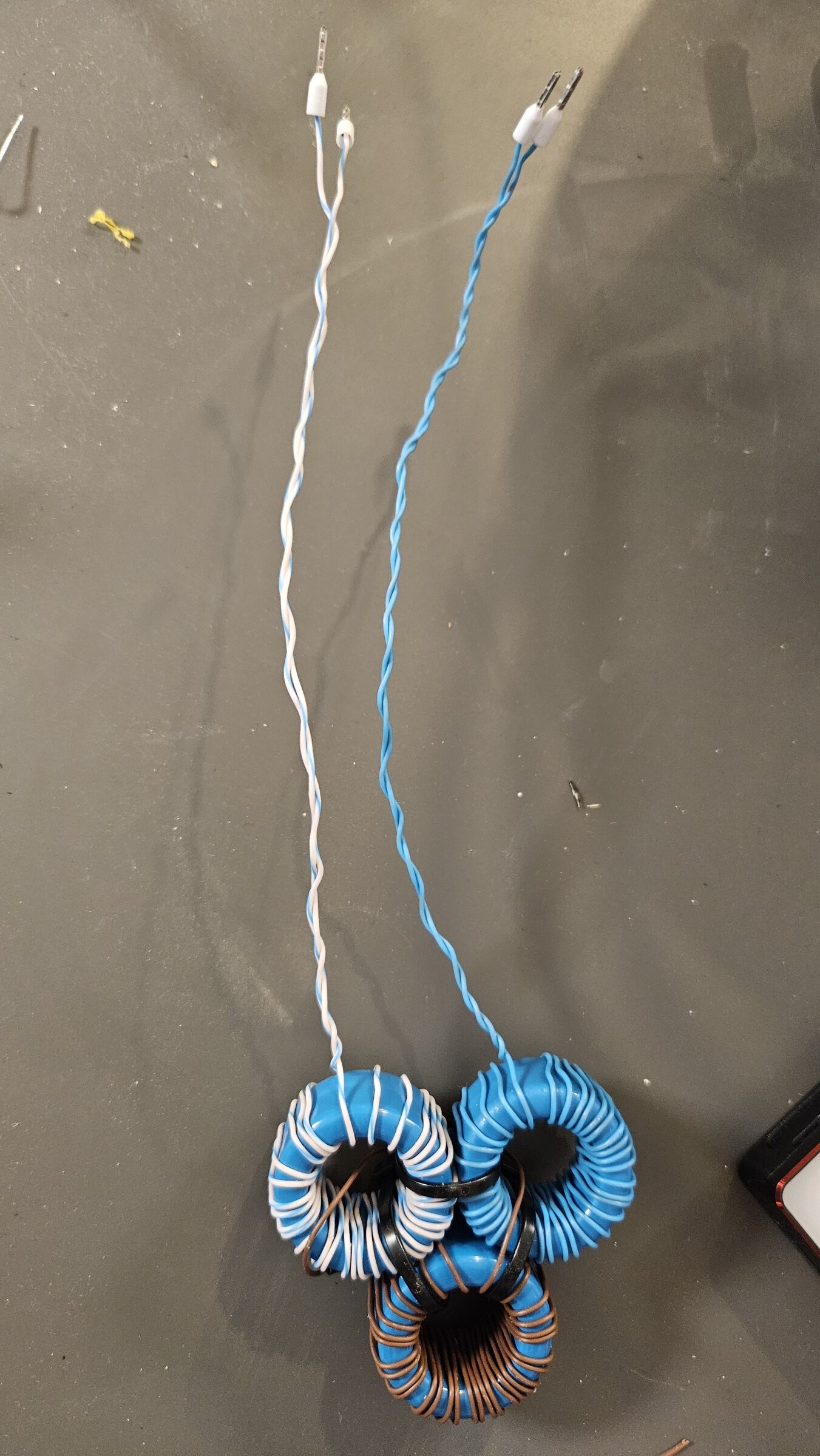
Current transformers was optimized to consume one ring core less. The primary ring core of the cascaded current transformer, has its wire go through two secondary ring cores, for two individual outputs. One output for feedback and one for over current detection, these two outputs can not be combined for the UD1.3 up to UD2.9 drivers.
Gate drive transformers was wrongly shown and made as half-bridge transformers. The GDT has to be with 4 outputs for the full-bridge. I was mistaken about pulse skipping drivers needing two individual GDTs, it is free wheeling drivers that needs separate GDTs.